
This stage applies the receptor impact model methodology to predict the response of the receptor impact variables to simultaneous changes in one or more of the hydrological response variables. The general framework allows for the receptor impact model to be applied either at a single or at multiple receptor locations, for example multiple locations that are considered to be representative of a landscape class within a bioregion or subregion. The receptor impact modelling elicitations, however, are designed for all locations within a landscape class given the same hydrology. The uncertainty in the elicited responses therefore represents the natural variability that one would expect in receptor impact variables that experience the same hydrological conditions at different locations in the landscape class, together with the experts’ uncertainty about this response.
The hydrology modelling produces simulated values from stochastic groundwater and surface water models that describe the uncertain impact of coal resource development pathways (CRDPs) on the hydrological response variables at a particular location (see companion product M09 (as listed in Table 1) for propagating uncertainty through models (Peeters et al., 2016)). The uncertainty from the hydrology modelling is propagated through the receptor impact model at each receptor location to deliver the predicted distribution of receptor impact variables at different time points for the two futures considered by BA (baseline and CRDP). Integrating over all of these receptors produces the overall predicted response of the receptor impact variable for the landscape class given the choice of the BA future. These landscape class results are summarised in product 3-4 (impact and risk analysis) for each bioregion or subregion (Figure 3). The method used for receptor impact model predictions is detailed below.
BAs assume that the only difference between the CRDP and baseline development pathway are those differences captured by the joint distribution of hydrological response variables provided by the stochastic hydrology modelling. All other variables that might also influence the receptor impact variables are assumed to behave in an identical fashion in a future world under baseline conditions, and a future world under the CRDP. To predict how receptor impact variables will respond to future changes in the hydrological response variables, the receptor impact modelling draws surface water and groundwater simulations from the joint distribution function,  , where
  represents the hydrological predictions under the baseline pathway (
 ) and
) and  represents hydrological conditions under the CRDP (
 ). For some hydrological response variables, such as surface water hydrological response variables that are aggregated to 30-year periods (Figure 11), the stochastic hydrological model output varies depending on the period of interest,
  ,
,  and
and  . Other hydrological response variables, however, are defined over the entire future period, such as the maximum depth of groundwater drawdown in the future period, in which case the values are the same for the short and long period,
  .
.
Figure 14 shows the temporal dependence in the hydrological response variables across years given a choice of development pathway. This is depicted, for example, by the connecting arrows in the first row of Figure 14, which shows that the future hydrological response variables for the baseline development pathway depend on what has occurred in the past. The second row shows that same temporal dependence for hydrological response variables in the coal resource development pathway. Within a particular period, the hydrological response variables may also depend on common factors that are shared across the two development pathways. Thus, Figure 14 shows between-year dependence and within-year dependence, for example, between hydrological response variables in the reference period for the two development pathways.
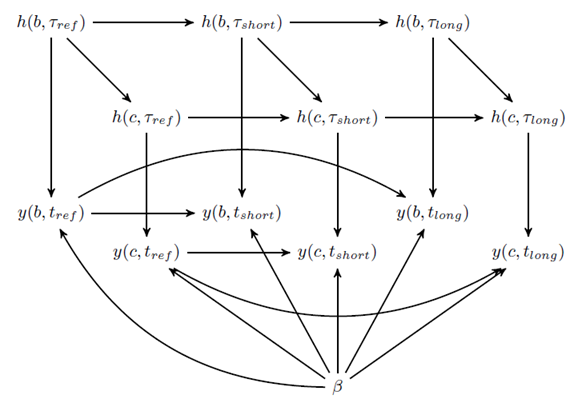
The choices of development pathways are  and
and  for assessment years 2012 (ref), 2042 (short) and 2102 (long). The parameter
  describes how the receptor impact variable in the current assessment year relates to hydrological response variables in the current assessment year and, for the future assessment years, the receptor impact variable in the 2012 assessment year.
Define the design point  , which depends on the model structure, the known hydrological response variable values
  , the known value for the receptor impact variable in the reference year
  , and the assessment year
  . In the reference year, the value of is fixed at zero and absorbed into the intercept (Section 5.1.2). Conditional on a set of known hydrological response variable values,
  and
and  , the joint distribution of the receptor impact variables in the reference assessment year for the two development pathways (Figure 14) is given by:
|
|
(38) |

where  is the inverse link function,
 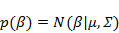 is the elicited prior and the normalising constant is
  .
.
The joint distribution of the receptor impact variables for both development pathways in the short-term assessment year is conditioned on the hydrological response variable values in the short-term assessment period, and also the receptor impact variables in the reference assessment year (Figure 14). This joint distribution conditional on the hydrological response variables is given by:
|
|
(39) |

Similarly, the distribution of the receptor impact variable in the long-term assessment year conditional on hydrological response variables is given by:
|
|
(40) |

Realisations from the joint distributions in Equations 38, 39 and 40 are obtained using Monte Carlo simulation (Section 8.2). During these simulations, the BAs impose perfect positive dependence in the samples drawn from  between development pathways within an assessment year in accordance with the assumption of BAs that, after accounting for the effect of hydrological response variables, receptor impact variables behave in an identical fashion under the baseline and CRDP.
Consider predictions for a particular location, or ‘assessment unit’ (defined as a geographic area that is used to partition the entire assessment extent into square polygons that do not overlap), denoted  . The predicted distributions for the assessment and future years are given by:
|
|
(41) |
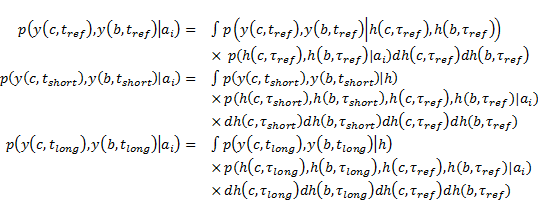
The distributions of the hydrological response variables in Equation 41 depend on both the choice of development pathway and the assessment unit. Simulated values from the joint distribution of the hydrological response variables for each assessment unit, 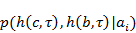 are provided by the surface water and groundwater models.
In addition to the above predictions, it is also of interest to consider functions of these unknowns. Two possibilities are considered for the future period: the actual change, 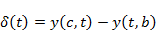 , and the relative change,
 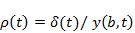 for
for 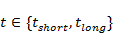 . These predictions depend on the hydrological response variables and are thus also spatially explicit, that is, dependent on the choice of the assessment unit:
|
|
(42) |
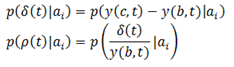
for the future assessment with .