
The companion submethodology M10 (as listed in Table 1 and Figure 3) for analysing impacts and risks (Henderson et al., 2018) lays out the definition of a receptor impact model in terms of what it needs to predict and the appropriate conditioning and uncertainty that it should incorporate. As discussed in companion submethodology M10 (Henderson et al., 2018), a receptor impact model is defined with respect to a particular landscape classification. It is associated with a particular receptor impact variable and hydrological response variables chosen from the conceptual modelling output. It is explicit about the temporal definition of the receptor impact variable. It describes how the receptor impact variable changes as the hydrological response variables change across the entire landscape class.
The receptor impact model predicts the value of the receptor impact variable at all locations across the landscape class that experience specific hydrological conditions. The uncertainty in these predictions represents the natural variability in the value of the receptor impact variable that would occur at different locations within the landscape class that experience the same hydrological conditions, and the experts’ uncertainty about how receptor impact variables respond to different hydrological conditions. The predicted value of a receptor impact variable is thus not the predicted response at a particular location within a landscape, which would depend on many additional localised factors such as land use.
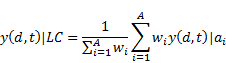
The receptor impact models are designed to facilitate prediction to the landscape class level while integrating across the spatially explicit hydrological response variables. This integration requires a quantifiable estimate of the amount of each landscape class within each assessment unit. Thus, a non-negative weight  is associated with each of the
  assessment units,
  ,
,  The weight is defined by the amount of the landscape class within each assessment unit. For linear landscape classes defined along stream reaches, it is the length of reach assigned to the landscape class within each assessment unit. For areal landscape classes, it is the area assigned to the landscape class within each assessment unit.
Since it is assumed that the receptor impact variable predictions for each assessment unit are conditionally independent given the hydrological response variables (Chapter 8), the landscape class averaged predictions are given by the weighted averages:
|
|
(43) |
where  ,
,  and
and  denotes dependence for the landscape class average on all assessment units, ,
  , that form the landscape class. Aggregating to the landscape class requires conditioning on all assessment units in the landscape class.
The landscape class averaged actual change and relative change are obtained by:
|
|
(44) |
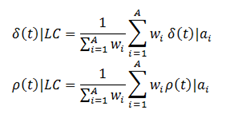
which is a weighted average of the individual assessment units. Relative change can be expressed as percentage change by multiplying the relative change by 100.