
The construction of receptor impact models for ecological assets and ecosystems presents great challenges. The first overarching challenge is that ecological systems are complex and constantly changing. There are inherent limits to explaining patterns and to predicting outcomes for ecological variables. Logically incorporating this predictability problem into an uncertainty analysis can be practically challenging to implement. It is therefore incumbent for the approach to document and demonstrate how it will quantitatively assimilate the current state of knowledge, and use this information in such a way to ensure the applicability of the general approach to a large number of assets with various spatial footprints and at different points in time.
The second challenge for ecological receptor impact models is the specific nature of the analysis. The analysis requires assessing impacts at different points in time. However, the hydrological impacts of coal resource development in the subregion or bioregion are non-stationary, that is, the impacts vary over time because of the timing of coal resource developments, the lagged response of hydrological response variables to development pressures, and the lagged response of receptor impact variables to changes in the hydrological response variables. Thus, while it is attractive to conceptualise the problem in terms of a comparison of the existing hydrological regime before coal resource development and the new regime after coal resource development, such a simple temporal breakdown does not adequately reflect key aspects of the problem. The hydrological regime will typically change continuously as coal resource developments begin and change their patterns of water use and management during different operational phases. At the end of the coal resource development, many aspects of the hydrological regime could potentially return to their previous state or alternatively undergo a perturbed trajectory. The transitory effects may not completely be exhausted even by the end of the longest-term projection for the receptor impact variable in a BA. Thus, the problem cannot be considered as a simple change of steady state.
The non-stationarity of hydrological impact also restricts the available data that can be used to empirically estimate a receptor impact model. Fundamentally, the sequence of hydrological changes may be a key determinant of change in the receptor impact variable. However, many of the hydrological changes, both in magnitude and sequence, may be novel in these systems. Sparse data will sometimes exist to empirically calibrate these relationships. The use of ecosystem modelling is similarly restricted by the lack of process knowledge and associated data to calibrate the relationships contained in the model. Techniques such as Bayes Nets could be considered (e.g. Marcot et al. (2001)), but they do not naturally accommodate spatial and temporal phenomena, and entail significant resources to parameterise.
The fractured nature of the knowledge base means that the use of expert opinion will typically be needed to construct receptor impact models, which can be assessed and updated with empirical data where possible. The experts can integrate their knowledge base to make predictions about likely outcomes related to hydrological change (O’Hagan, 1998). Carefully constructed questions help experts focus on the key issues that need to be considered and elicit their response in a structured and transparent way.
The elicitation process requires careful construction (O’Hagan et al., 2006). It is well known that poorly designed elicitations can seriously impact on the reliability of the results. Ambiguous questions mean that experts may misunderstand the task and introduce additional uncertainty into the analysis. Poor processes can lead to problems, such as dominance of debate by vocal individuals. Inadequate protocols can lead to issues, such as anchoring, where experts do not explore the full extent of their knowledge and beliefs. Unorganised, inefficient or unclear protocols can confuse experts and lead to burn out or decreased motivation, which leads them to drop out from the elicitation process. There is also a balance between choosing a protocol that is simple to explain versus a complex protocol that requires substantial training and time commitment of experts. A very pragmatic protocol is one that allows experts to contribute their knowledge early without too much education on the elicitation process. On the other hand, overly simplistic protocols may not elicit the experts’ knowledge correctly and can also lead to confusion on the nature of what exactly was elicited if the education portion of the elicitation process is reduced too much. These trade-offs are of particular importance for receptor impact models deployed in a BA, where many such models are developed across a subregion or bioregion and the demand for expert involvement and motivated participation is essential for successful completion of each task. Ideally, the same experts will be involved for deriving conceptual models and also the quantitative probabilistic receptor impact models. But the method described here also allows for the pragmatic cases where different experts contribute at various times, for example, because of availability limitations or a shift in the focus of domain expertise for a given landscape class.
The opinions expressed by different experts will sometimes disagree. This fact simply reflects variation in their understandings and beliefs and so does not directly undermine the use of the approach. However, it means that the choice of experts can have a material effect on the analysis, so the elicitation needs to be done in a consistent, flexible and principled way. In some senses, the experts operate as a jury. Provided the experts represent the diverse views across the relevant informed community within their consensus opinion, readers will have confidence that a wide range of informed opinions have been considered and reported in the Assessment. The choice of experts, including their identification, invitation and participation in the process, needs close attention to ensure appropriate expertise is included. In practice, expert availability can be a non-trivial constraint. The expert invitation process was a collaborative effort among the Office of Water Science, the Bureau of Meteorology and the BA ecology discipline teams for each bioregion or subregion, which provided communication channels to key regional institutions and individuals with a wide range of expertise.
Ultimately, however, the best way to assess the experts’ judgement is to collect relevant empirical data wherever possible. Experts will be encouraged to include knowledge of existing empirical data from independent sources within their assessments. A very important additional objective of the receptor impact model approach is to allow for the coherent incorporation of relevant empirical data if it were to become available. These data may be obtained through a defined monitoring program that targets a receptor impact variable as part of validating (or invalidating) the risk predictions and the characterisation of the receptor impact model. This goal for coherent data assimilation dictates the choice of model structure, which must allow for potentially very different forms of ecological data, such as continuous (e.g. abundance), non-negative integers (e.g. counts), binomial counts (e.g. percent cover) or binary (e.g. presence–absence) responses. This goal, which seeks to ensure the coherent updating of uncertainty estimates given potential empirical data, also guides the selection of the receptor impact variable, where it forms a clear criterion that any selected receptor impact variable must at least in principle be measurable. Such a requirement additionally ensures that the target receptor impact variable is both well-defined and also accessible to expert assessment.
In summary, the risks in the use of expert-based information can be managed by appropriate protocols and procedures. The workflow for ecological receptor impact modelling is outlined in Figure 4. Input from independent external ecology experts contributes to the workflow at three separate stages, as does hydrological modelling simulation output and the expertise of the BA hydrology modellers. Both the external experts and the hydrologists contribute to the selection of hydrological response variables that are ecologically meaningful and also amenable to hydrology modelling. The careful definition of landscape class forms the spatial context for the expert elicitation and receptor impact model analysis (Chapter 2). Experts should be engaged in a structured way with strong facilitation to ensure clarity of communication and focus on the issue in question. Elucidation of the ecological ecosystem within a landscape class is conducted at a qualitative modelling workshop that maps the key ecological variables, hydrological response variables and the linkages among these variables (Chapter 3). This modelling exercise is used to choose key hydrological response variables and receptor impact variables to progress for a receptor impact model analysis (Chapter 4). Based on the selected hydrological response variables and receptor impact variables, an efficient design of elicitation scenarios is constructed, which directly addresses the resource and time limitations imposed by expert availability (Chapter 5). The expert education and elicitation process as experienced by the experts and its theoretical underpinning is given in Chapter 6. The derivation of the receptor impact model and prediction methods are given in Chapter 7 and Chapter 8. Each stage is described in the following subsections.
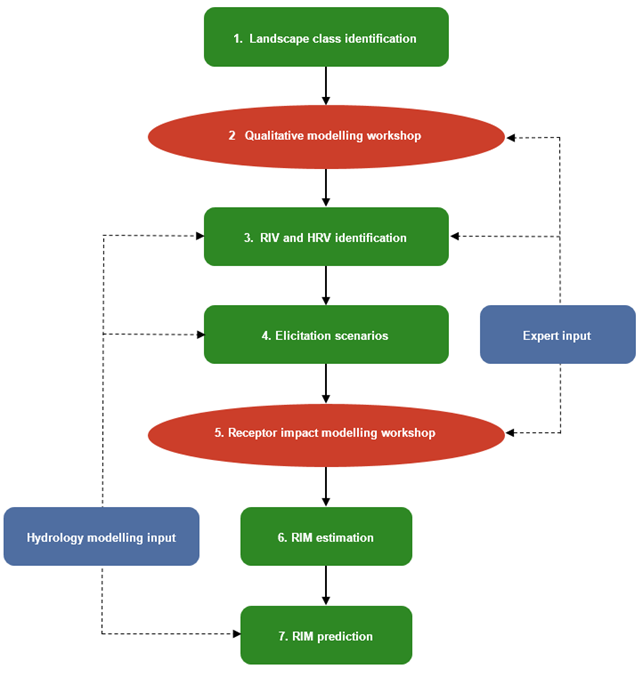
The workflow leads to the construction of a receptor impact model (RIM) that predicts the response of a receptor impact variable (RIV) conditional on hydrological response variables (HRVs). The uncertainty encapsulated by the hydrology modelling is propagated through the RIM when predicting the RIV response to the choice of BA futures (baseline or coal resource development pathway) across a landscape class. Workshop steps are shown in red, ecology and hydrology expert input sources are shown in blue.