
Receptor impact modelling is integral to undertaking the impact and risk analysis of a bioregional assessment (BA). The Methodology for bioregional assessments of the impacts of coal seam gas and coal mining development on water resources (the BA methodology; Barrett et al., 2013) states:
Modelling and analysis of the direct, indirect and cumulative impacts of coal seam gas (CSG) and coal mining development on anthropogenic and ecological receptors is the pivotal component of a BA.
The receptor impact model predicts how a receptor impact variable (a variable for which water-related impacts on assets are to be assessed) responds to direct, indirect and cumulative impacts of CSG and coal mining development. Although the BA methodology gives a high-level overview of the components required for a BA, it is not sufficiently detailed to clearly guide Assessment teams performing specific assessment tasks. This submethodology provides the explicit detail needed to develop the receptor impact models that are required to assess the potential impacts from CSG and large coal mining on receptor impact variables. This M08 report is a methodology report that provides the technical detail underlying the reporting in technical products 2.7 and 3-4. A quantitative, numerical and probabilistic modelling approach is described. The Assessment teams can use this method to undertake probabilistic assessment for a receptor impact variable as required by BA. The receptor impact modelling methodology was purposely developed to enable coherent assimilation of empirical data if permitted by available resources within the BA Programme. The methodology describes the generation of a probabilistic prior that can be updated with empirical data where available.
Receptor impact models are functions that translate hydrological changes into the distribution of potential economic, sociocultural and/or ecological outcomes that may arise from those changes (see product 2.7 (receptor impact modelling) for applied examples, Figure 3). Within BAs, hydrological changes are described by hydrological response variables. Hydrological response variables are defined as hydrological characteristics of the system that potentially change due to coal resource development (for example, drawdown or the annual flow volume). They are thought to be instrumental in maintaining and shaping the ecological components, processes and values provided by the ecosystems in each landscape class. Examples of hydrological response variables are found in product 2.7 (receptor impact modelling) (Figure 3). A receptor impact variable is defined as a characteristic of the system that, according to the conceptual modelling, potentially changes due to changes in hydrological response variables (for example, condition of the breeding habitat for a given species, or biomass of river red gums). Economic, sociocultural or ecological outcomes are represented by receptor impact variables, and a receptor impact model portrays the relationship between a particular receptor impact variable (e.g. the percent foliage cover of woody riparian vegetation) and one or more hydrological response variables (e.g. the change in depth to groundwater).
Receptor impact models are only developed for ecological receptor impact variables in BAs. Potential impacts on economic assets were assessed in BAs by estimating the changes to the availability of groundwater and surface water (see product 3-4 (impact and risk analysis) for details, Figure 3). Likewise, some sociocultural assets have a direct relationship with groundwater and surface water and are treated similarly to economic assets. Other sociocultural receptor impact variables may have an ecological component that can be assessed by an ecological receptor impact model.
Ecological receptor impact modelling is the focus of this submethodology: a method is provided that links hydrological response variables to receptor impact variables enabling prediction of ecological responses to coal resource development. The hydrological response variables may interact with and produce cumulative impacts on an ecological receptor. Ecological receptor impact models quantify the potential impacts on water-dependent assets that may have ecological value. In the ecological scientific literature, receptor impact models are often known as ‘ecological response functions’ (Boulton et al., 2014). This submethodology develops a novel approach to constructing ecological response functions that allows for direct, indirect and cumulative impacts, while coherently incorporating uncertainty, expert assessments and potentially empirical data.
Two potential futures are considered by BAs:
- baseline coal resource development (baseline): a future that includes all coal mines and CSG fields that are commercially producing as of December 2012
- coal resource development pathway (CRDP): a future that includes all coal mines and CSG fields that are in the baseline as well as those that are expected to begin commercial production after December 2012.
The difference in results between the CRDP and baseline is the change that is primarily reported in a BA. This change is due to the additional coal resource development – all coal mines and CSG fields, including expansions of baseline operations, that are expected to begin commercial production after December 2012. BAs focus solely on water-related impacts, and specifically those related to water quantity and availability. Potential water quality hazards and pathways are identified but any (qualitative) analysis is limited to salinity as other water quality impacts beyond the scope of BA.
Ecological receptor impact models in BAs are relevant to specific landscape classes that are potentially impacted by the additional coal resource development over the baseline, encapsulated by the CRDP. A landscape class is defined as an ecosystem with characteristics that are expected to respond similarly to changes in groundwater and/or surface water due to coal resource development (companion submethodology M03 (as listed in Table 1) for assigning receptors to water-dependent assets (O’Grady et al., 2016); companion submethodology M05 (as listed in Table 1) for developing a conceptual model of causal pathways (Henderson et al., 2016)). For each potentially impacted landscape class, the overall conceptual approach is to propagate uncertainty from hydrological models into receptor impact models (see companion submethodology M09 (as listed in Table 1) for propagating uncertainty through models (Peeters et al., 2016)). The probabilistic outputs from the hydrology models, which depend on the choice of futures (baseline or CRDP), become the inputs into the receptor impact models. The receptor impact models, in turn, produce probabilistic predictions of the receptor impact variables conditional on the hydrological inputs. This approach thus provides a coherent probabilistic assessment of the receptor impact variable while accounting for the direct, indirect and cumulative impacts of CSG and coal mining development.
The receptor impact modelling described by this submethodology is a crucial part of the cumulative impact and risk analysis process used in a BA (Component 3 and Component 4; Figure 3). Receptor impact modelling is a key step of the risk analysis as it converts the potentially abstract information about hydrological changes to ecological variables of scientific interest that stakeholders care about and can more readily understand and interpret. In particular, outcomes of the modelling will relate more closely to their ecological values and beliefs and therefore support community discussion and decision making about acceptable levels of coal resource development.
Receptor impact models may be constructed for three types of asset groups: economic, sociocultural and ecological. An overview of the construction of the receptor impact model for the three asset groups is provided in this section. The primary focus of this submethodology is on ecological assets; only ecological receptor impact models were developed. Subsequent sections concentrate entirely on ecological assets. Any subregion-specific deviations from this approach, or gaps and limitations, are addressed in product 2.7 (receptor impact modelling) for that subregion.
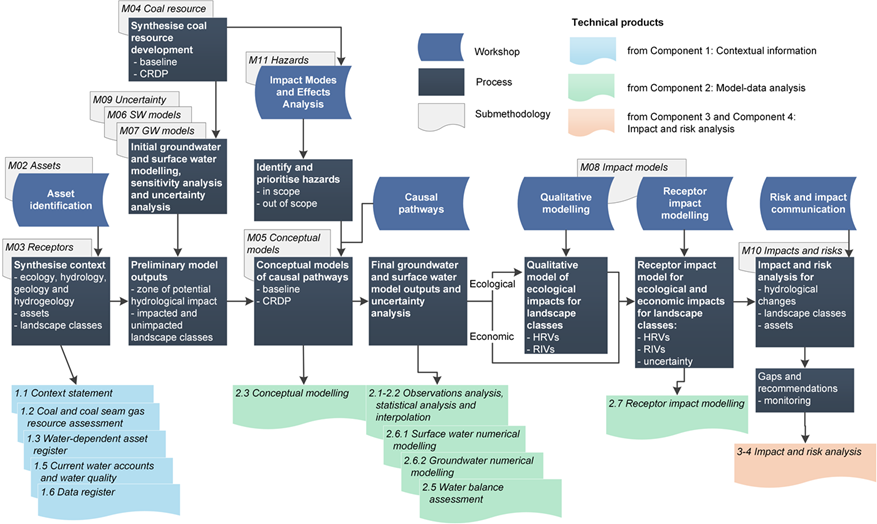
CRDP = coal resource development pathway, GW = groundwater, HRVs = hydrological response variables, RIVs = receptor impact variables, SW = surface water